19–27 JULY 1952 · WASHINGTON, DC · 38.9072, -77.0369
The Washington, D.C. radar incidents
On two consecutive weekends, radar at National Airport and Andrews AFB tracked unknown targets over the capital while airline crews reported lights; jets were scrambled, and the Air Force gave the largest press conference since the war to explain it.
Shortly before midnight on 19 July 1952, the Air Route Traffic Control Center at Washington National Airport picked up seven unknown targets southwest of the city. Over the following hours they appeared over the White House and the Capitol on multiple scopes, were tracked simultaneously by National and Andrews AFB radar, and were correlated in several instances with lights reported by airline pilots — Capital Airlines Flight 807 among them. F-94 interceptors arrived after the targets faded. The following weekend it happened again, and this time the interceptors were on scene while targets held on scope; pilot William Patterson described lights that surrounded his aircraft and outpaced it.
The 'Washington flap' produced front pages nationwide and, on 29 July, a press conference by Maj. Gen. John Samford, Air Force Director of Intelligence — the largest since the Second World War. Samford attributed the returns to temperature inversion effects, in which sharp atmospheric layering bends radar to paint ground clutter as moving targets, and the lights to stars and meteors refracted by the same air.
The inversion explanation was endorsed by the Civil Aeronautics Administration's later technical study and remains the official account. It is contested on the record by several of the radar operators on duty, who maintained the returns behaved like solid targets and that inversions that night were too weak; the simultaneous radar-visual correlations remain its most argued point. The flap directly precipitated the CIA's Robertson Panel of January 1953, which reframed the subject as a problem of public order rather than of intelligence — a decision whose consequences the rest of this archive documents.
The artifacts
Hosted by this archive from the cited originals — the record you can look at.
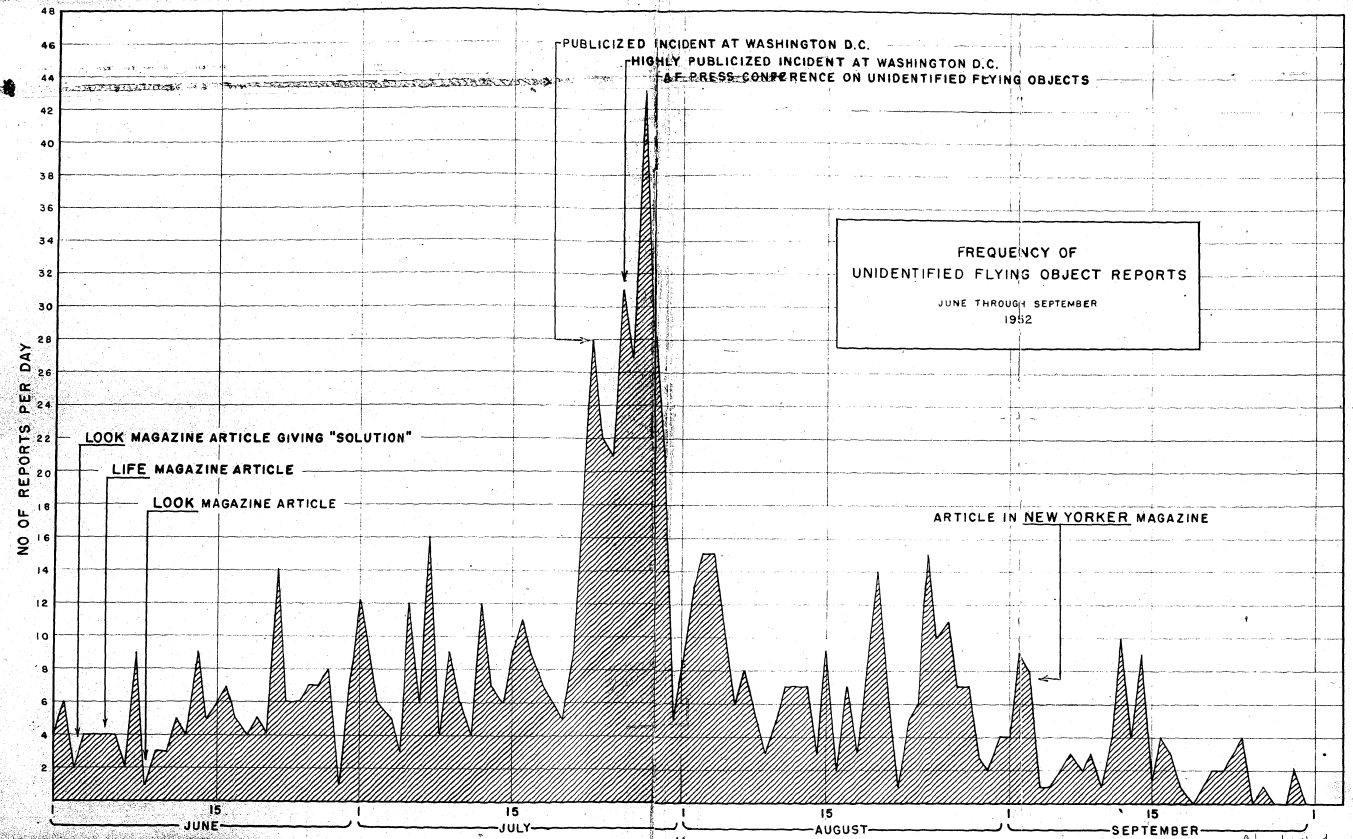
Air Force graph of the 1952 report wave
The service's own frequency chart of incoming reports, with the July spike that buried Blue Book's phone lines drawn in its own hand.
United States Air Force · Public domain (U.S. government work) · source

Ask for more
Parts of this record remain unreleased. Through Aletheca, anyone can commission the next request — filed and chased in the open, refusals published with the same weight as releases. The draft goes over already written: the records sought, and a window wide enough to catch the paperwork that followed the event.
Routed to: National Archives and Records Administration · records window 1952-07-12 → 1952-08-26